The Matching Set Myth: How to Make Accessories Feel Cohesive
The matching set myth says accessories must agree exactly. Use repetition, contrast, or one shared visual cue to make a personal outfit feel coherent.
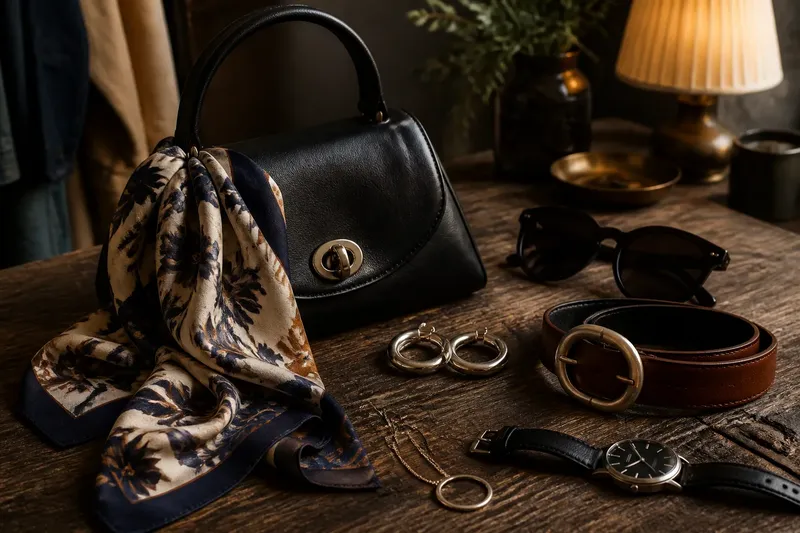
The most common mistake with accessories is buying every piece in the same finish, then wearing them as a set because anything else seems mismatched. The matching set myth can leave an outfit feeling assembled rather than personal; coherence needs a relationship between pieces, not identical twins.
A black leather bag, brown belt, silver hoops, and patterned scarf can belong together if the eye has a reason to move between them. These field notes offer three such reasons: repetition, deliberate contrast, and a shared visual cue.
Repeat a detail
Repetition is the easiest route to a connected look. Choose one visible feature—shape, texture, motif, or finish—and let it appear in two or three places, while allowing the rest of each accessory to differ.
For instance, rounded forms can recur in small hoop earrings, the curved buckle on a belt, and the handle of a bag. The pieces need not share a material or color; the repeated contour is enough to give the eye a quiet pattern to follow.
- Repeat a shape: Pair a circular pendant with rounded sunglasses or a softly curved bag clasp.
- Repeat a texture: Let a woven belt echo the basket-like surface of a bag, without matching their colors.
- Repeat a motif: A small star on a scarf can reappear as a subtle charm on a key ring or bag.
- Repeat a finish: Brushed metal on a watch can relate to a matte buckle, even if their shapes differ.
Keep the repeated feature visible but not crowded. If every accessory repeats several details at once, the outfit may look like a coordinated set after all.
Pick one detail to echo, then let the other pieces bring their own character.
Use contrast on purpose
Contrast creates coherence when the difference is clear and intentional. A polished metal watch beside a soft leather bracelet can look considered because each texture makes the other easier to notice; unrelated pieces, by comparison, can feel accidental.
Try pairing one refined element with one relaxed one: a slim chain with a chunky knit scarf, a structured bag with a fabric belt, or delicate earrings with a broad, matte cuff. Keep a shared anchor elsewhere, such as a similar scale, a recurring curve, or a color already present in the clothing.
Contrast can also come from proportion. A small pendant against a broad neckline creates a focal point, while a larger pendant can hold its own over a plain top. Look at the outfit from a few steps away: if the accessories compete for attention, reduce the number of strong contrasts.
Imagine you are wearing a navy coat, a narrow tan belt, and silver earrings. Adding a glossy black bag might seem like one more unrelated finish; choosing a bag with a curved handle instead echoes the earrings’ shape, so the different colors and materials have a visible link.
Choose one shared cue
A shared visual cue is broader than a matching color. It could be an overall mood, a reference to a material, or a line that repeats across the outfit. A scarf with a botanical print and a plain leather bag, for example, can connect through the organic shape of the print and the natural grain of the leather, even though neither item repeats the other exactly.
Choose the cue before adding the final accessory. If the outfit already has a crisp, geometric feel, angular sunglasses or a rectangular bag may extend that idea. If it feels soft and fluid, a rounded clasp or draped scarf can carry the same impression without requiring identical shades.
One cue is usually enough. Treat it as a thread running through the look, not a theme that every item must illustrate.
Where can accessories differ?
Can gold and silver be worn together?
Yes. Give the metals a visible connection through repeated shapes, a mixed-metal piece, or a shared level of shine. A polished silver watch and a brushed gold ring feel more deliberate when another accessory brings those finishes together.
How many accessories should share a detail?
Two clear echoes often create a stronger link than repeating the same feature everywhere. If three pieces already share a motif, keep the remaining accessories simpler so the motif stays legible.
Does a bag have to match shoes?
No. Connect the bag and shoes through another element, such as a repeated texture, shape, or formality. A smooth leather bag can sit comfortably with suede shoes when the rest of the outfit supports that difference.
What if an accessory feels out of place?
Ask what feature it contributes and whether that feature appears anywhere else. If there is no useful connection, try moving the piece to another part of the outfit or replacing it with something that supports the look’s existing cue.
Read the whole outfit
Accessories do not work in isolation. A belt can repeat a shoe’s texture; earrings can pick up a neckline’s shape; a bag can introduce contrast that the clothing already makes room for. Judge the relationship against the clothes and the occasion, not against a rule that every item must pair off neatly.
Start with the piece you most want to wear, then add one accessory that repeats a detail or shares a cue. Bring in a contrasting piece only if it has a clear role, and remove anything that draws attention without adding a useful connection.
The matching set myth is easy to leave behind: aim for a recognizable thread, not a perfect match. When checking whether accessories feel coherent, look for the one detail that carries the eye from one piece to the next; that is often all the outfit needs.